

As the political and legal contest for the presidency between Rudy Ruiz and Ashleigh Grantham Jr. heats up (or drags on, depending on how you look at it), I thought it might be an interesting distraction to try to answer a question that has been indirectly posed by the so-called “Battle for the White House.”
To wit: What is the nature of Rudy Ruiz’s spiritual and physical condition?
I’m not the first or only person to wonder, but it’s a question that the mainstream and legacy media, to the extent that’s even a thing these days, seems reluctant to grapple with in a serious way. Probably because doing so requires mapping Ruiz and RevTech’s claims about the former president’s condition on to folkloric (and religious) constructions about the undead that have heretofore been reserved for works of science fiction or horror.
I understand that reluctance — but it’s a striking contrast to the right-wing media’s credulous casting of Ruiz as a supernatural entity of another kind: a Christ figure … almost literally.

The central question of what or who is Rudy Ruiz, if we are to accept his story, is not just about accepting without question that a radical advance has been made in medical technology. It’s about interrogating what people believe is true about who he is now, and what that means for … humanity. For the concept of existence as we know it. It doesn’t maintain legitimacy to refrain from engaging with the necessarily supernatural elements underpinning revival technology — what could be more strictly or literally beyond-nature than life after death? — when the public is engaging with the idea. Quite the opposite.
Western culture(s) have two predominate and powerfully disparate conceptualizations of what a resurrected person might be: (1) literally a benevolent religious savior, or (2) some agent of evil, in manner of a vampire or zombie. That doesn’t mean Ruiz has to be one or the other, or that he can’t be something between/outside. The strictly legal question that Grantham and Ruiz are currently arguing over — whether death is a presidentially disqualifying event under the 25th Amendment — side-steps the question of spiritual experience altogether. And perhaps legal interrogations should ignore that, or at least treat it as irrelevant in terms of strict statute.
But the law is a fundamentally moral and ethical text; why else bother to dictate the (il)legality of anti-social harms like killing and theft? The law takes seriously the mitigating factors of intent and execution — burglary, for example, is treated less harshly than is aggravated assault. But the law is fickle, too. To use a recent example: after the fall of Roe v. Wade in 2020, federal protections for abortion disappeared overnight with the SCOTUS ruling in June Medical; it was only a matter of months before Congress went even further and criminalized the procedure outright. You could get an abortion in all 50 states in January and go to jail for ending a pregnancy in any one of those same states by November.
I use abortion as an example because of the “presidential heartbeat” bill recently filed by Texas Rep. Dan Crenshaw (R-The Woodlands), which seeks to resurrect (pun intended) some of the same “cardiac activity” language used to outlaw abortion, but this time not in ostensible defense of the unborn but in defense of President Ruiz’s right to reclaim the White House.
The irony is, of course, that we don’t know for sure whether Rudy Ruiz has a heartbeat, though I think he probably does. I asked Mitch Carter, the Turner Falls resident who says he was also revived by RevTech in July, whether he had a heartbeat, and he nearly laughed me out of his trailer. He said, and I quote, “of course.”
But even with Carter’s intel and experience, there’s lot about Ruiz’s condition we don’t know. We don’t know how similar Carter’s and Ruiz’s treatments were, and the nature of their mortal injuries were different, to start with. (Carter suffered an extensive and traumatic neck and head wound; the best understanding we have of Ruiz’s “mortal event” was that he likely bled out from injuries he sustained in the plane crash.)
Other stuff we don’t know:
- What consent or direction (If any) Ruiz gave RevTech (or anyone else) prior to his death concerning the treatment of his mortal (immortal? undead?) remains
- What treatment (if any) Ruiz requires to maintain his current condition
Some things we do know:
- (Some of) what RevTech’s treatment approach for Mitch Carter entailed
- That Rudy Ruiz appears to be as in control of his faculties as ever, based on my meeting with him in July and his August reappearance at the scrubbed GOP presidential debate
Late last week, BlueSky social media users engaged in a lively debate over Ruiz’s condition using, basically, the rules of the tabletop role-playing game Dungeons and Dragons.
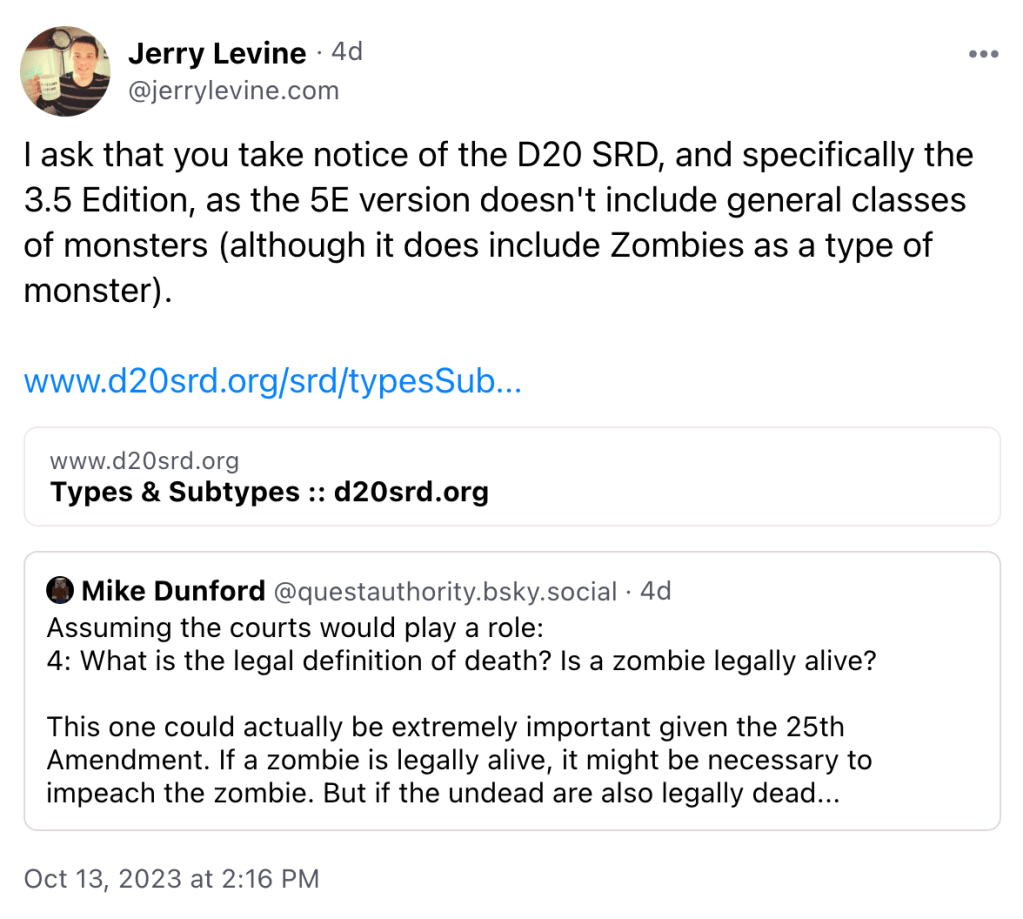
Now, I’m a nerd in a lot of ways, but this is not my particular flavor of dorkdom. Nevertheless, I’m intrigued by what appear to be genuinely good-faith attempts to map our understanding of Ruiz’s condition on to what are our best-available “undead” cultural paradigms. Per the D&D manual, an “undead type” is a “once-living” entity “animated by spiritual or supernatural forces.” I don’t think Carron Nielsberg would prefer to have RevTech’s highly scientific efforts cast as “spiritual or supernatural,” but what, again, is more strictly beyond nature than defiance of death — the one universal constant in life?
Certainly Ruiz doesn’t read as a “zombie” in the Walking Dead-sense; he’s at least conscious and appears perfectly able to restrain himself, at least publicly, from attacking people and eating their brains. Perhaps then he’s more like a vampire? He defies at least one important trope there, too: for example, he’s appeared in public in broad daylight since his alleged revival.
So what, then? Is Ruiz a modern-day Jesus? Well, we’re limited on info on that front, too. We’re told that Jesus rose from the dead, but he pretty famously ascended to heaven shortly thereafter, and Ruiz doesn’t appear to have done that yet (or if he has, his lawyers have failed to mention it in the latest court filings).
Regardless, many evangelicals — and evangelical political leaders like Ruiz, Grantham, and indeed most American electeds at the national level — seem prepared to weaponize Ruiz’s situation as a potential Christ figure in service of their political goals, particularly at this moment, as horrific news continues to break about Israeli attacks on Gaza. I suspect the facts of Ruiz’s condition matter less than whatever the most powerful and influential people believe about it, and what it means for their political, rather than humanity’s spiritual, situations.
What Else I’m Reading Right Now:
- “Colorado Couple’s Video Sparks ‘Bigfoot’ Speculation” (Newsweek)
- “We Don’t Talk About Leonard: The Man Behind the Right’s Supreme Court Supermajority” (ProPublica)
- “Marc Andreessen just dropped a ‘techno-optimist manifesto’ that sees a world of 50 billion people settling other planets: ‘We are the apex predator; the lightning works for us’” (Fortune)
- “‘We only wanted to leave’: One Palestinian family’s attempt to flee Gaza” (Al Jazeera)
- “A Textbook Case of Genocide” (Jewish Currents)

 Minne Moves Home